

Why Most Startups Fail
Common Early-Stage Mistakes and How to Avoid Them
The Startup Genome project analyzed more than 3,200 high-growth technology companies and found that 90% fail. Harvard Business School lecturer Shikhar Ghosh looked at 2,000 venture-backed startups and found that 75% never return cash to investors.
In 30-40% of those cases, investors lose everything. The Bureau of Labor Statistics reports gentler numbers for traditional businesses: 50% fail within five years, 70% within ten. But traditional businesses are not startups. Startups pursue scalable, innovative models under extreme uncertainty. That risk profile is different.
CB Insights tracked 431 VC-backed companies that shut down between 2023 and 2025. These companies raised a combined $17.5 billion before dying. The median raised $11 million. The median time from last fundraise to death was 22 months. A quarter of the failed startups had not raised new capital in over three years before shutting down. They were walking dead long before anyone called it.

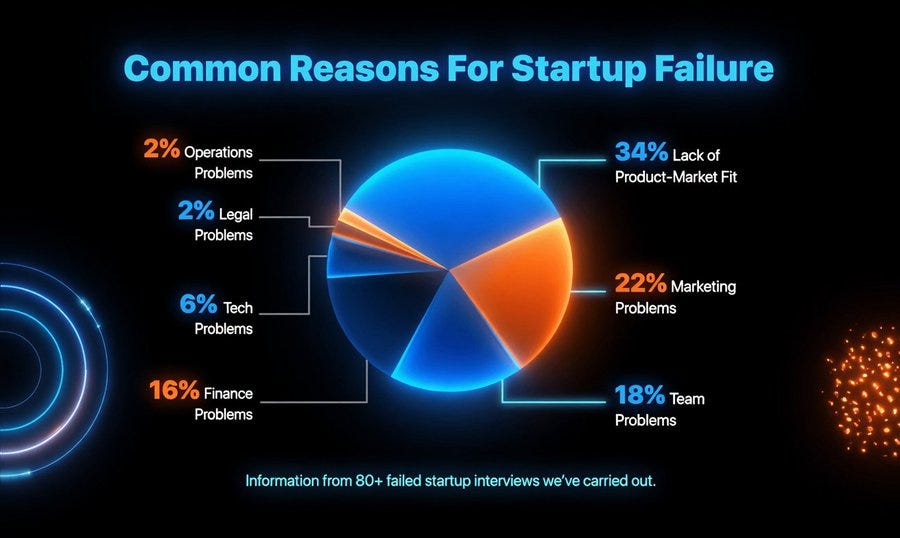
Failory interviewed founders from 80+ failed startups. Marketing problems accounted for 56% of the failures. Team problems contributed 18%. Finance problems: 16%. Technology problems: 6%. Operations and legal issues made up the remaining 4%. These categories overlap. A founder who reports “ran out of money” and a founder who reports “no one wanted our product” are describing the same death from different angles.
Building Something Nobody Wants Is the Single Cause That Funnels All Others
Paul Graham, cofounder of Y Combinator, wrote in 2006 that most startup failures trace back to one mistake: not making something users want. CB Insights data confirms this. Forty-three percent of failed startups cited poor product-market fit as a primary cause. It was the most common root reason after running out of cash.
Two-thirds of the product-market fit failures were early-stage companies that never found a market. But 20 companies that reached Series B or later also cited poor product-market fit. Zume raised $446 million through Series C for robot-made pizza. It pivoted to sustainable packaging. It failed anyway. Venture funding can delay a reckoning. It cannot substitute for demand.
A 2024 study in Frontiers in Psychology analyzed 50 startup postmortems and identified two competency deficits that predicted failure: information-seeking and customer service orientation. Founders who stopped looking for market signals and stopped responding to customer needs died at higher rates. The finding tracks with Graham’s observation that companies solving a problem the founders experienced themselves tend to outperform companies built on assumptions about a demographic the founders do not belong to.
The fix: find one specific user and build for them. Graham says solve a problem you have yourself. If you build for others, talk to them before you write code. Test your hypotheses with a minimum viable product. The Startup Genome project found that startups testing their market assumptions directly survive at higher rates than startups building in isolation.
Premature Scaling Turns Unvalidated Assumptions Into Expensive Mistakes
Startup Genome identified premature scaling as the primary cause of failure. Seventy percent of the startups in its dataset showed this pattern. No startup that scaled prematurely passed 100,000 users. Ninety-three percent never broke $100,000 in monthly revenue. Startups that scaled well grew about 20 times faster.
Premature scaling means hiring a team, buying ads, renting office space, or adding product complexity before you know people want what you are building. Startup Genome divides company building into four stages: Discovery, Validation, Efficiency, and Scale. Companies that skip stages are “inconsistent.” These inconsistent startups wrote 3.4 times more code during Discovery and 2.25 times more code during Efficiency than their consistent peers. They raised three times more capital during Efficiency but 18 times less during Scale. They burned their fundraising capacity before they reached a stage where capital helps.
Graham saw the same problem from a different angle. Hiring too many people too early cuts both ways. It increases costs. It slows development. Fred Brooks documented this in The Mythical Man-Month: adding people to a late project makes it later. Graham’s rule: hire only people who write code or go out and get users. Those are the only functions that matter before product-market fit.
The fix is deliberate stage-gating. Do not hire a sales team until customers have proven they will buy. Do not enter new markets until your core market shows repeatable growth. Sequoia Capital published a framework in 2026 describing three phases: opening (idea to product-market fit), midgame (company building), and endgame (scale). Founders who try to play all three at once without mastering the opening do not survive the midgame.
Runway Is a Symptom, Not a Strategy
Running out of cash led the CB Insights list at 70%. The firm’s analysts note that this is almost always the final cause, not the root cause. The median failed startup raised $11 million and died 22 months after its last fundraise. A quarter of the failed companies had not raised money in over three years.
Graham distinguished three capital mistakes that look alike from the outside. Raising too little leaves you without enough runway to reach the next milestone. Spending too much burns whatever capital you have. Raising too much creates pressure from investors to spend fast, which means premature scaling, loss of focus, and reduced ability to change direction.
The best-funded failures show all three patterns. Olive, a healthcare AI automation startup, and Convoy, a digital freight brokerage, both hit about $4 billion valuations during the pandemic boom. Both raised about $1 billion. Both shut down within two weeks of each other in October 2023 when market conditions shifted. Their funding did not protect them. It may have made the collapse worse by delaying the reckoning.
The fix: treat fundraising as a means to a specific milestone, not as validation. Graham recommends taking the first reasonable offer from a reputable investor instead of bargaining for a better deal. Time spent fundraising is time not spent building. Raise enough to reach the next visible step (prototype to launch, launch to significant growth) and keep spending minimal. More than 50% of failed startup founders interviewed by Failory did not have a budget.
Team Structure Predicts Failure More Than Any Other Controllable Factor
Single-founder startups carry a structural disadvantage that compounds across every dimension of early-stage risk. Graham listed this as the first of his 18 mistakes. Successful startups founded by one person are rare. A single founder has no one to share the low points with, no built-in brainstorming partner, and signals to investors that nobody else believed in the idea enough to join.
Failory found that team problems contributed to 18% of failures. Specific issues included lack of domain knowledge, lack of marketing expertise, co-founder friction, and uneven commitment. Graham said about 20% of Y Combinator-funded startups experienced a founder departure. Most of these disputes could have been avoided by being more selective about cofounders from the start.
Hiring mistakes follow predictable patterns. Forbes HR Council contributor Blair Slaughter identified hiring too quickly as the most common error. Bad hires cost more than salary. They damage strategic momentum and team morale. Graham emphasized that non-technical founders who hire programmers to implement their vision almost always fail because they cannot tell good engineers from bad ones. The best engineers do not want to work for someone else’s vision.
The fix: prioritize co-founder selection above all other early decisions. Do not include someone out of politeness or fear of not finding anyone else. For hiring, hire only when the absence of the hire is causing the company to fail. Hire only for roles that build the product or acquire users. Pay with equity, not salary. You want people committed to the outcome, not the paycheck.
Founders Who Do Not Talk to Users Are Flying Blind
Graham identified having no specific user in mind as one of the 18 mistakes. He called it dangerous territory when founders build products for demographics they do not belong to. His advice: find specific users, watch them use the product, measure their responses.
The Frontiers in Psychology study backs this up. The two competency deficits that predicted failure best were information-seeking and customer service orientation. Founders who sought market feedback and oriented their development around customer needs outperformed those who did not.
CB Insights data shows that product-market fit failures are not limited to early-stage companies. Late-stage companies that raised on early traction and widened into a real market prove that funding can sustain operations indefinitely without solving the customer demand problem. Those founders knew their early adopters. They learned how to reach a broader market.
The fix: launch quickly and iterate based on what users do. Graham argued that launching slowly kills a hundred times more startups than launching too fast. Early adopters are forgiving of incomplete features. They are unforgiving of products that solve no real problem. Release a working subset early. The feedback will shape the full product better than any amount of planning.
The Commitment Gap Separates Survivors From Statistics
Graham’s final mistake (a half-hearted effort) may be the most common failure mode. The startups that fail most quietly are not the ones that make spectacular errors. They are side projects. People keep their day jobs, tinker on evenings and weekends, and let the idea fade without ever reaching escape velocity.
Startup Genome found that startups need two to three times longer to validate their market than most founders expect. Founders who cannot commit full-time run out of time before they run out of ideas. Graham estimated that the number of people who could have succeeded if they had quit their day job is an order of magnitude larger than the number who do.
Failory’s research confirms that most failed startup founders were self-funded and did not have a budget. The constraint that killed them was not money. It was attention. A startup requires concentrated effort over an extended period. Divided attention (from a day job, from multiple projects, from a founder who is not all in) produces results that look like progress but never compound into a sustainable business.
Many aspiring founders assess that their idea is not worth the leap and they are right. But if you have a genuine insight and the determination to pursue it, understand this: partial commitment is a form of failure. The startups that survive tend to be the ones where the founders made the leap. Not because the leap guarantees success. Because those who take it are the ones who try hard enough to discover whether their idea works.
How These Patterns Interact
These mistakes are not independent. A founder who builds something nobody wants will run out of money. A founder who raises too much will face pressure to spend it, which drives premature scaling, which makes it harder to pivot when the product does not fit the market. A founder who hires too quickly and hires the wrong people builds a team that cannot respond to customer feedback, which cements the original product-market misfit. A founder who does not commit fully will never push through the iterative cycle that product-market fit requires.

CB Insights data shows measurable leading indicators. Among companies tracked over 12 months before shutdown, 72% saw their Mosaic score decline. Scores dropped by 15% on average. Partnership activity dropped 44% from 12-24 months before death to the final 12 months. Two-thirds of failed companies were shrinking headcount in the six months before death. These signals accumulate over a year or more. There is time to correct course.
The question every founder should ask is whether anyone wants what you are building. Money, team, and product polish matter less than that single answer. Every other mistake funnels through that one.